
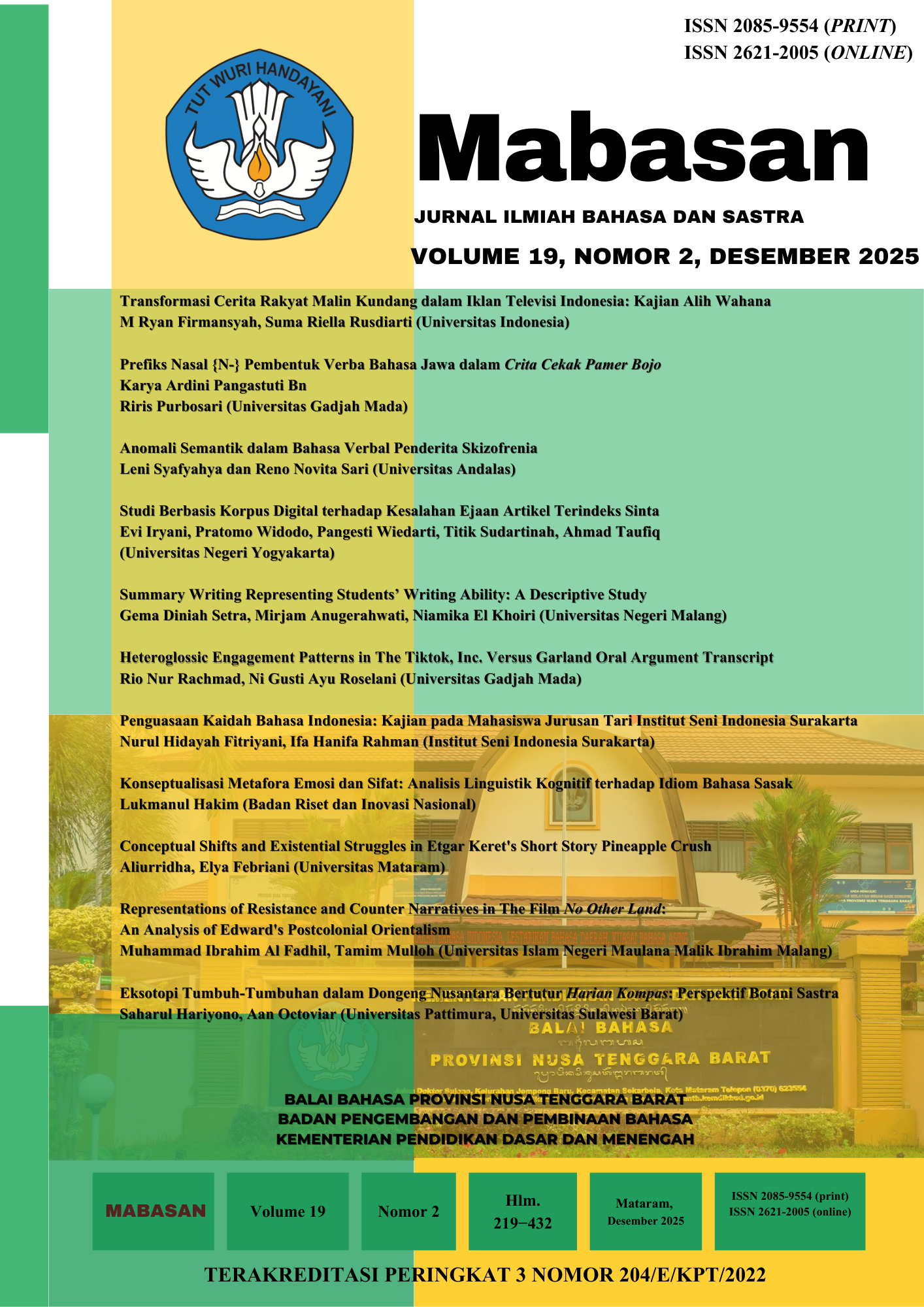
REPRESENTATIONS OF RESISTANCE AND COUNTER NARRATIVES IN THE FILM NO OTHER LAND: AN ANALYSIS OF EDWARD'S POSTCOLONIAL ORIENTALISM
DOI:
https://doi.org/10.62107/mab.v19i2.1136Keywords:
No Other Land; resistance; counter-narrative; orientalismAbstract
The Palestinian-Israeli conflict is a complex and protracted geopolitical issue, in which Israel's colonial practices against Palestine continue until today. The documentary film No Other Land directly records the destruction of Palestinian villages in Masafer Yatta as well as forms of resistance by the local community. The main issue of this research is the need to reveal how the film No Other Land presents resistance and counter-narratives to the dominance of Orientalist representations. This research aims to show that No Other Land is not only a documentation of reality, but also a medium that affirms the agency, dignity, and identity of the Palestinian people. This study uses Edward Said's framework of Orientalism to analyze how the film depicts power relations, colonial practices, and counter-narratives born out of Palestinian resistance. Using a qualitative descriptive approach, data were collected through observation of scenes, dialogues, and visuals in the film, then categorized into verbal, symbolic, and historical forms of resistance. The study's results identified 21 instances of resistance, including 10 verbal, 8 symbolic, and 3 historical, as well as 7 instances of counter-narratives that serve to deconstruct the Orientalist discourse portraying Palestine as weak and passive. These findings show that No Other Land is not merely a documentation of suffering, but also a political medium that reclaims the representation of Palestine in the eyes of the world. Thus, documentary films can be understood as a space for cultural resistance that affirms the identity, dignity, and rights of colonized peoples.Downloads
References
Adra, B., & Szor, R. (2025). No Other Land ( 2024 ), by Hamdan Ballal , Yuval. 13(1), 141–144.
Andalas, E. F. (2016). Citra Antikolonial Dalam Film Avatar (2009): Sebuah Tinjauan Poskolonial. Puitika, 12(1), 1. https://doi.org/10.25077/puitika.12.1.1--10.2016
Badri, B., Ihsanullah, A., & Heriyanti, L. (2023). “The Forbidden Kingdom”: Dari Representasi sampai Dependensi Kajian Orientalisme Edward Said. JENTERA: Jurnal Kajian Sastra, 12(1), 37. https://doi.org/10.26499/jentera.v12i1.4711
Bangsa, J. P. (2022). Film Ip Man 4 : The Finale dalam Tinjauan Poskolonial. CALATHU: Jurnal Ilmu Komunikasi, 4(1), 42–55.
BUKU TEORI SASTRA.pdf. (n.d.).
Daisuke Akimoto. (2025). Beyond Orientalism? Evolving Political Correctness in Disney’s Live-Action Film Aladdin (2019). International Journal of Linguistics, Literature and Translation, 8(4), 107–116. https://doi.org/10.32996/ijllt.2025.8.4.13
Dapit, A., Waluyo, P., & Trisari, A. (2020). Resistensi Dalam Novel Hulubalang Raja Karya Nur Sutan Iskandar: Kajian Poskolonial. Jurnal Salaka : Jurnal Bahasa, Sastra, Dan Budaya Indonesia, 2(2), 66–75. https://doi.org/10.33751/jsalaka.v2i2.2485
de Figueiredo, W. R. (2025). Orientalism and Representations of Hua Mulan: A Comparative Analysis of the 2020 Film Adaptations. Journal of Cultural Analysis and Social Change, 10(1), 02. https://doi.org/10.20897/jcasc/16522
Fanon, F. (1963). The Pitfalls of National Consciousness. In The Wretched of the Earth.
Fanon, F. (1986). Black skin, white masks (C L Markmann, Trans. Original work published 1952). 232.
Hassan, H., & Lee, T. M. (2023). Orientalism and Colonial Legacies in Bollywood’s Film Earth (1999). Al-Qanṭara, 9(4), 43–55. https://alqantarajournal.com/index.php/Journal/article/view/400
Komoditisasi, K., Tanamanang, D., & Timur, S. (n.d.). Resistensi Sehari-hari Petani di Daerah Sabana Terhadap Pembangunan Ekonomi Desa.
Lassner, J. (2013). Orientalists. In Jews, Christians, and the Abode of Islam. https://doi.org/10.7208/chicago/9780226471099.003.0001
Nassaji, H. (2015). Qualitative and descriptive research : Data type versus data analysis. https://doi.org/10.1177/1362168815572747
Nisa, S. F., Ihtisani, A. F., & Zahrotul, I. (2025). The Idea of Postcolonial Literary Criticism in Tasting the Sky : A Palestinian Childhood Novel by Ibtisam Barakat. 10(1), 1–10.
Said, E. (1977). ORIENTALISM. The Georgia Review, 31(1), 45.
Said, E. (1993). Culture and Imperialism.
Street, O. W., Loomba, A., & Bryson, C. (n.d.). COLONIALISM / POSTCOLONIALISM.
Susanto, H., Irmawati, I., Akmal, H., & Abbas, E. W. (2021). Media Film Dokumenter dan Pengaruhnya Terhadap Keterampilan Berpikir Kritis Siswa. HISTORIA: Jurnal Program Studi Pendidikan Sejarah, 9(1), 65. https://doi.org/10.24127/hj.v9i1.2980
Wibisono, J. A., Tjahjo, J. D. W., & Wahjudianata, M. (2017). Representasi Orientalisme Dalam Film the Great Wall. Scriptura, 7(1), 36–45. https://doi.org/10.9744/scriptura.7.1.36-45
Yasa, I. N. (2014). ORIENTALISME, PERBUDAKAN, DAN RESISTENSI PRIBUMI TERHADAP KOLONIAL DALAM NOVEL-NOVEL TERBITAN BALAI PUSTAKA. Jurnal Ilmu Sosial Dan Humaniora, 2(2). https://doi.org/10.23887/jish-undiksha.v2i2.2179
Published
How to Cite
Issue
Section
Copyright (c) 2025 Balai Bahasa Provinsi NTB

This work is licensed under a Creative Commons Attribution 4.0 International License.
- Author grant the journal right of first publication with the work simultaneously licensed under a Creative Commons Attribution License that allows others to share the work with an acknowledgement of the work’s authorship and initial publication in this journal.
- Authors are able to enter into separate, additional contractual arrangements for the non-exclusive distribution of the journal’s published version of the work (e.g., post it to an institutional repository or publish it in a book), with an acknowledgement of its initial publication in this journal.
- Authors are permitted and encouraged to post their work online (e.g., in institutional repositories or on their website) prior to and during the submission process, as it can lead to productive exchanges, as well as earlier and greater citation of published work.
- Every accepted manuscript should be accompanied by "Copyright Transfer Agreement"prior to the article publication.